
Case Study

Halemi Lehar

Halemi Lehar (translating to “Queer Revolution”) seeks to mobilize the term “halemi” as a political and organizing category to center the needs, politics, and experiences most marginalized within the Sikh community. Halemi Lehar strives to challenge the hegemonic understandings and claims to Sikhi that continue to otherize and dispose of marginalized Sikhs.

Halemi Lehar logo.
Halemi Lehar logo.
Halemi Lehar logo.
Halemi Lehar logo.
Halemi Lehar logo.

Halemi Lehar

Context

Despite Sikhi’s foundations being in a radical commitment to anti-oppression, hegemonic forces and individual complicities have significantly diluted and co-opted Sikhi’s foundation and commitments. Halemi Lehar is a collective of Sikhs within North America to address this dilution. As strangers who had met during a conference organized by a Sikh organization, their shared disappointment and disillusionment with both the conference, attendees, and the Sikh organizing space inspired them to form Halemi Lehar from their collective heartbreak.  

Halemi Lehar (translating to “Queer Revolution”) formalized with a small group of Sikhs seeking a space to tend to the constant heartbreak of being failed by the larger Sikh community. Finding affirmation in the Sikh Guru’s directive to build a “halemi raaj” translating to the “rule of the oppressed, powerless, the meek, the Othered,” [they envisioned] a lehar (translating to “wave”, “movement”, or “revolution”) that mobilizes the term “halemi” as a political and organizing category to center the needs, politics, and experiences of those living through ongoing moments of violence and genocide within and beyond the Sikh community. These include, but are not limited to, experiences with and beyond rampant casteism, heterosexism, anti-Blackness, anti-Indigeneity, anti-queerness, anti-transness, Islamophobia, capitalism, and/or ableism.

Halemi Lehar

Problem

Halemi Lehar sought to politically re-establish Sikhi’s unapologetic call for the abolition of all systems of hierarchy and oppression during a time when mainstream Sikh conversations continue to uphold and maintain systems of oppression. However, to challenge and organize against the overlapping systems of oppression within and beyond the Sikh community, Halemi Lehar needed to develop content and resources since there is a lack of critical content that is not casteist and brahminical, misogynist, anti-Black, queerphobic, transphobic, and, at large, oppressive.

Halemi Lehar

Vision

Halemi Lehar’s goal was to center queer, femme, transgender, Dalit and caste oppressed, Black, disabled, and other marginalized groups within the Sikh community by producing content and creating spaces that follow abolitionist, anti-caste, feminist, queer, and trans centric frames of operation rooted in Sikhi. Halemi Lehar proposed a multi-pronged project organized around five distinct components:

1. Content and Resources

Produce and uplift critical content creation, exploring the very foundational and basic concepts in Sikhi through abolitionist, anti-caste, feminist, queer, and trans centric politics.

2. Power Building Retreat

Organize an in-person retreat that will bring together Dalit and caste oppressed, femme, queer, transgender, Black, disabled, and other marginalized Sikhs to build Sangat (community), while reclaiming Sikhi in its original abolitionist frame of operation and thought.

3. Community Conference

Building on the insights from the retreat, organize an open conference open to the Sikh community and beyond.

4. Website and Media Development

Design a website and utilize other media platforms to share content and resources produced and to establish a stream of content that aims to take back control of Sikh narratives by centralizing marginalized Sikh identities and groups. Doing so will also further share ways for Sikhs and beyond to access Sikhi from a more critical and anti-oppressive narrative.

5. Coalition Building

Support coalition and relationship-building efforts across different movements, such as panels and conversations, to cement the commitment of Halemi Lehar both within and beyond the Sikh community.

Halemi Lehar

Experience of the Project

To realize this ambitious vision, the members of Halemi Lehar began by building their own organization. The members started by discussing what the structure and vision of Halemi Lehar should be. In addition to writing a vision statement, the collective met “to critically engage with scripture.” Since these study groups were intended to be a major offering of Halemi Lehar, the collective prioritized this “spiritual, political education” amongst themselves first. These gatherings included each member making a presentation on scripture and then facilitating discussions to foster reflection. As a member shared, these study groups were “a huge opportunity for us to kind of develop our own selves and our own kind of skills, our own knowledges so I think for one that was that that like this project kind of facilitated such a space and such an investment in our own selves individually and collectively.”

In response to the escalation of the genocide against Palestinians, Halemi Lehar mobilized around supporting and standing up in solidarity with Palestine and Palestinians. Collaborating with artists and organizations, Halemi Lehar pursued the following Sikh-Palestinian solidarity work.

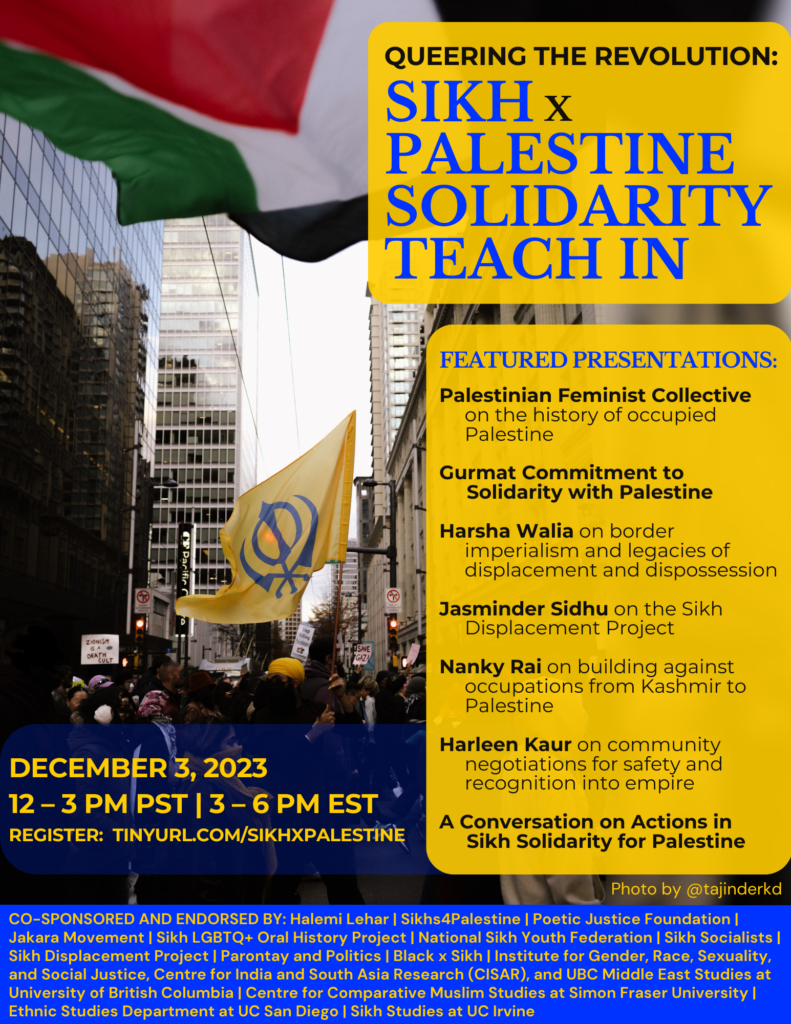
Flyer for Sikh and Palestine Solidarity Teach-In.

Sikh4Palestine Instagram Account

  • Sikh artists donated art
  • Raised $1000 for Palestinian solidarity efforts
  • Inspired a conversation for Sikhs to consider their role in this moment

Queering the Revolution: Sikh x Palestine Solidarity Teach-In

Teach-in organized with scholars, activists, and organizations that created a space to think about queerness, Palestine, and Sikhi together.

  • Over 500 people registered, with 200 people actually attending throughout the day
  • Co-sponsored by 16 organizations and collectives:
    • Halemi Lehar
    • Sikhs4Palestine
    • Poetic Justice Foundation
    • Jakara Movement
    • Sikh LGBTQ+ Oral History Project
    • National Sikh Youth Federation
    • Sikh Socialists
    • Sikh Displacement Project
    • Parontay and Politics
    • Black x Sikh
    • Institute for Gender, Race, Sexuality, and Social Justice, Centre for India and South Asia Research (CISAR), and UBC Middle East Studies at University of British Columbia
    • Centre for Comparative Muslim Studies at Simon Fraser University
    • Ethnic Studies Department at UC San Diego
    • Sikh Studies at UC Irvine
  • YouTube Recordings

Sikh Commitment to Solidarity with Palestine Letter

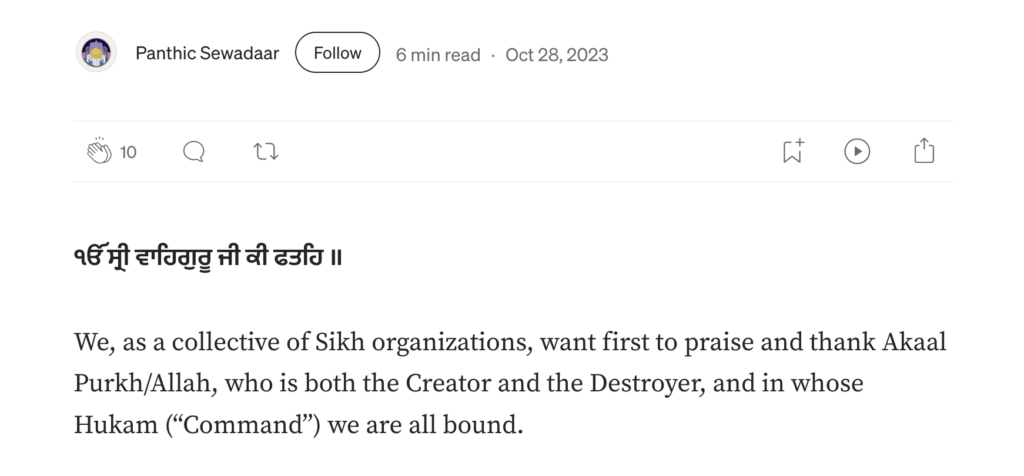
Read the letter on Medium.

While Halemi Lehar was very active at the start of their grant, the reality of building an organization from the ground up compelled them to pursue their vision differently. To begin, Halemi Lehar lacked the necessary organizational infrastructure (i.e., EIN and bank account) to receive the grant funds from an institution, which prevented them from utilizing the grant for over half the granting period. Also, the labor and time of building an organization was compounded by the everyday demands of life and shifts in career. 

In the end, the members chose to collaborate with existing organizations with the necessary organizational infrastructure to fund projects that aligned with their original collective vision. They disperse their granting funds to support the following projects and organizations:

Sikh Research Institute

Organization website.

  • An organization doing “critical work in understanding Sikhi that is prioritizing anti-caste, feminist, queer epistemologies.”
  • Sidak Leadership Program: Halemi Lehar’s grant funds supported Sidak, a summer retreat, by bringing and creating safe spaces for queer, trans, and caste-oppressed Sikhs.
Sikh LGBTQIA+ Oral History Project

Organization website.

  • First and largest archive of oral histories of queer and trans Sikhs. 
  • Halemi Lehar is still working with the project to plan how to utilize the grant funds, probably to expand the archive in its engagement.

Halemi Lehar

Lessons Learned

Although frustrations with existing organizations inspired Halemi Lehar to dream a new organization, their experience of actualizing their vision humbled them. Appreciating how hard it is to build and sustain an organization, the members learned there is value in working within existing organization, building upon work that has already happen to strengthen it. Finally, working with established organizations can contribute to the sustainability of the project and the individuals who pursue it. 

Halemi Lehar

Question Worth Asking Yourself

Why or why not is working with existing organizations to pursue your vision possible?

What is involved in creating an organization?

To receive a grant from an institution, what do I need?

How can a collaborate with other to realize my vision of change?

Scroll to Top